(per room, table above)
Enter the room's square feet and pick your state, and get the BTU/h the room needs, the standard mini split size to look at, and whether you need to check the unit's heating capacity in cold weather.
Mini split size by room
C02Scenario A
Sets the electricity rate. Pick US average if you're not sure.
From EIA for US average. Use the rate on your bill if you know it.
Rate used: 18.4¢/kWh · US average · EIA reference 2025–26 · climate zone 4 (data as of 2026-09-26) ·
Mini split size (next size up)
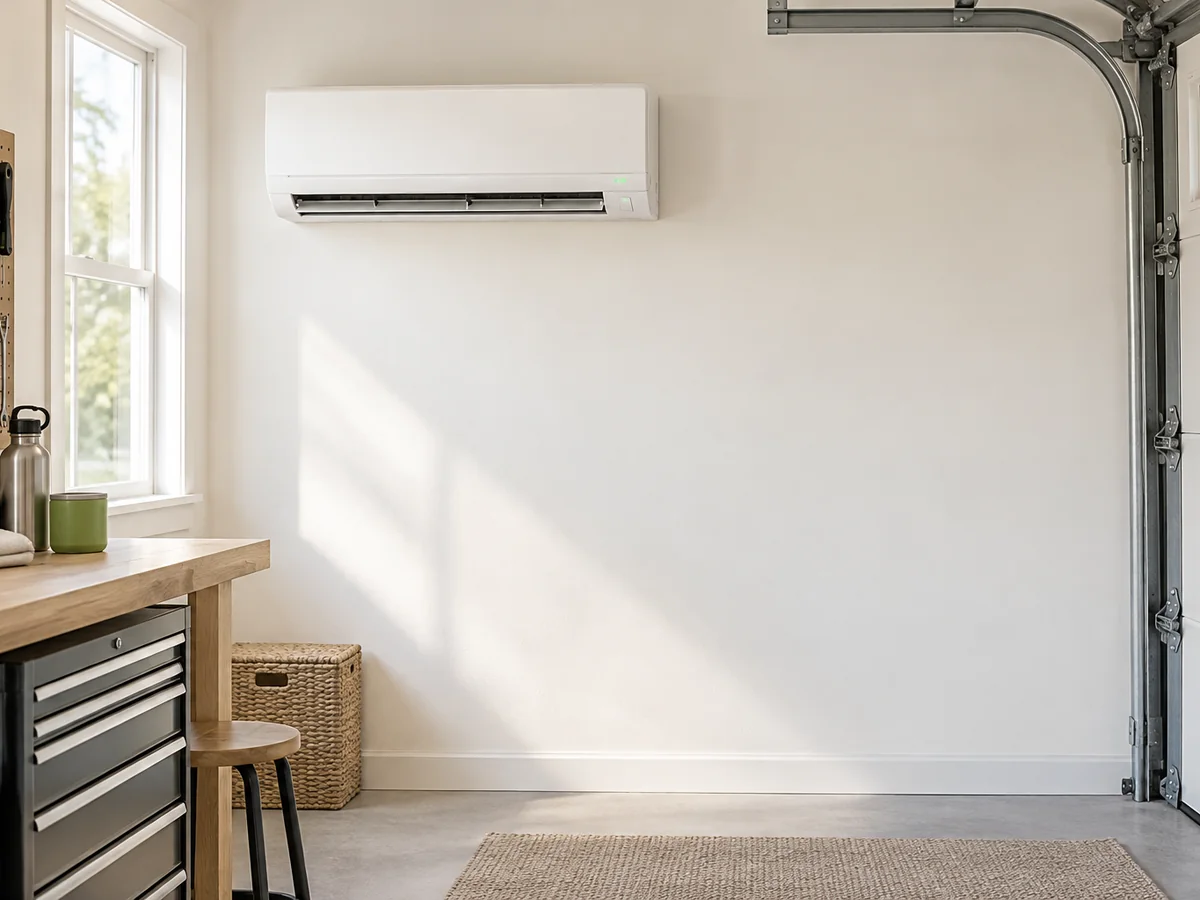
15,000 BTU/h for a 500 sq ft garage in US average (climate zone 4).
- Room factor
- 1.50
- Recommended BTU/h
- 15,000
- Nearest standard size
- 12,000 BTU
- Next size up
- 18,000 BTU
- Heating check (zone 5+: capacity at 5 °F)
- Not critical in this climate
Estimate. Formula and sources are under “How it works”. Change any input; the result updates as you type.
Formula
How it works
- Recommended BTU/h = square feet × 20 × zone factor × room factor
- Zone factor (from your state's IECC climate zone): zone 1 = 1.3, 2 = 1.2, 3 = 1.1, 4 = 1.0, 5 = 0.9, 6 = 0.85, 7 and 8 = 0.8
- Room factor: bedroom 1.0 · garage 1.5 (assumes an uninsulated garage door) · sunroom 1.4 (glass) · basement 0.7 (walls against the earth)
- Standard size = the closest of 9,000, 12,000, 18,000, 24,000 or 36,000 BTU
- Heating check: in climate zone 5 and colder, the page flags that you should check the unit's rated heating capacity at 5 °F, because a mini split puts out less heat as the outdoor temperature drops.
Sources: 20 BTU/sq ft base: ENERGY STAR room AC sizing. Room factors: installer practice, a simplified ACCA Manual J. Climate zone: IECC 2021 (DOE/PNNL).
Worked example
A worked example
Minnesota is climate zone 6 (zone factor 0.85), and a basement gets a room factor of 0.70 because its walls sit against cool earth. 800 sq ft × 20 × 0.85 × 0.70 = 9,520 BTU/h. The closest standard head is 9,000 BTU. Because Minnesota is zone 6, the heating check says yes: look up the unit's heating capacity at 5 °F before you buy.
Reference
By state, at the default inputs
Mini split size (next size up), with this page's default inputs and each state's reference prices (EIA reference 2025–26, data as of 2026-09-26).
| US average | 18,000 BTU | 18.4¢/kWh |
|---|---|---|
| Alabama | 18,000 BTU | 15.5¢/kWh |
| Alaska | 12,000 BTU | 25.0¢/kWh |
| Arizona | 18,000 BTU | 15.0¢/kWh |
| Arkansas | 18,000 BTU | 13.0¢/kWh |
| California | 18,000 BTU | 32.0¢/kWh |
| Colorado | 18,000 BTU | 16.0¢/kWh |
| Connecticut | 18,000 BTU | 30.0¢/kWh |
| Delaware | 18,000 BTU | 17.0¢/kWh |
| District of Columbia | 18,000 BTU | 19.0¢/kWh |
| Florida | 18,000 BTU | 15.0¢/kWh |
| Georgia | 18,000 BTU | 14.5¢/kWh |
| Hawaii | 24,000 BTU | 42.0¢/kWh |
| Idaho | 18,000 BTU | 12.0¢/kWh |
| Illinois | 18,000 BTU | 17.0¢/kWh |
| Indiana | 18,000 BTU | 15.5¢/kWh |
| Iowa | 18,000 BTU | 13.5¢/kWh |
| Kansas | 18,000 BTU | 14.5¢/kWh |
| Kentucky | 18,000 BTU | 13.0¢/kWh |
| Louisiana | 18,000 BTU | 12.5¢/kWh |
| Maine | 18,000 BTU | 26.0¢/kWh |
| Maryland | 18,000 BTU | 19.0¢/kWh |
| Massachusetts | 18,000 BTU | 29.0¢/kWh |
| Michigan | 18,000 BTU | 19.5¢/kWh |
| Minnesota | 18,000 BTU | 15.5¢/kWh |
| Mississippi | 18,000 BTU | 13.5¢/kWh |
| Missouri | 18,000 BTU | 13.0¢/kWh |
| Montana | 18,000 BTU | 13.0¢/kWh |
| Nebraska | 18,000 BTU | 12.0¢/kWh |
| Nevada | 18,000 BTU | 15.0¢/kWh |
| New Hampshire | 18,000 BTU | 27.0¢/kWh |
| New Jersey | 18,000 BTU | 22.0¢/kWh |
| New Mexico | 18,000 BTU | 15.0¢/kWh |
| New York | 18,000 BTU | 25.0¢/kWh |
| North Carolina | 18,000 BTU | 14.5¢/kWh |
| North Dakota | 12,000 BTU | 11.5¢/kWh |
| Ohio | 18,000 BTU | 16.5¢/kWh |
| Oklahoma | 18,000 BTU | 13.0¢/kWh |
| Oregon | 18,000 BTU | 14.5¢/kWh |
| Pennsylvania | 18,000 BTU | 18.5¢/kWh |
| Rhode Island | 18,000 BTU | 29.0¢/kWh |
| South Carolina | 18,000 BTU | 15.0¢/kWh |
| South Dakota | 18,000 BTU | 13.0¢/kWh |
| Tennessee | 18,000 BTU | 13.5¢/kWh |
| Texas | 18,000 BTU | 15.5¢/kWh |
| Utah | 18,000 BTU | 12.0¢/kWh |
| Vermont | 18,000 BTU | 22.0¢/kWh |
| Virginia | 18,000 BTU | 15.5¢/kWh |
| Washington | 18,000 BTU | 12.0¢/kWh |
| West Virginia | 18,000 BTU | 15.5¢/kWh |
| Wisconsin | 18,000 BTU | 17.5¢/kWh |
| Wyoming | 18,000 BTU | 12.5¢/kWh |
Questions
FAQ
What size mini split for a 2-car garage?
A 480 sq ft garage at the US average zone factor needs 480 × 20 × 1.0 × 1.5 = 14,400 BTU/h. In Texas (zone 2), the 500 sq ft test case comes to 18,000 BTU/h, an 18,000 BTU head. Insulating the garage door brings the room factor down; the calculator assumes it isn't insulated.
Can a mini split heat a garage in winter?
Yes, if its heating capacity holds up at your winter temperatures. In climate zones 5 and colder (for example Minnesota, Illinois, Maine) the page flags a heating check: find the unit's rated output at 5 °F in its spec sheet, and compare it with the BTU/h above.
What size mini split for a sunroom?
Glass lets in a lot of sun, so a sunroom gets a factor of 1.4. A 300 sq ft sunroom needs 8,400 BTU/h at the US average and 10,080 BTU/h in Florida (zone 2).
What size mini split for a basement or a bedroom?
A basement needs less: an 800 sq ft basement comes to 11,200 BTU/h at the US average, 9,520 BTU/h in Minnesota. A 300 sq ft bedroom at the US average needs 6,000 BTU/h, below the smallest standard head of 9,000 BTU.
What if the recommended BTU/h falls between two sizes?
The standard-size line shows the closest size, which can be the smaller one. For a room that's hard to cool (sun, a garage door, people), pick the size at or just above the recommended BTU/h.
Related